TARGETED SMALL-GROUP INTERVENTION FOR SECONDARY SCHOOLS
When young people struggle to express themselves, the impact can reach far beyond the classroom.
Some pupils withdraw from discussions, find it difficult to communicate their feelings or struggle to connect with others. These challenges can affect their confidence, participation and sense of belonging.
Finding Your Voice offers a structured, supportive environment where secondary-school pupils can develop greater self-awareness through guided reflection and conversation, creating a foundation for confidence, communication and connection.

Begin with a three-week pilot, giving your school the opportunity to experience the approach and review its suitability before deciding whether to continue.
What Schools May Be Seeing
Some pupils become quieter or less engaged, struggle to connect with others, or lack confidence in speaking up and sharing their perspective.

WITHDRAWING
Pupils who rarely contribute, appear disengaged or find it difficult to share what they're thinking and feeling.

STRUGGLING TO CONNECT
Young people who find it difficult to build relationships, communicate with others or feel a sense of belonging.

LACKING CONFIDENCE
Pupils who hesitate to express their opinions, question their abilities or worry about how others might respond.
These experiences can have many different causes, and every pupil is different. However, for some young people, additional opportunities for reflection, communication and supportive connection may be a valuable part of their development.

We often encourage young people to speak up, believe in themselves and become more confident. But for some, the first step may be recognising what they're thinking, understanding how they're feeling and discovering what matters to them.
Finding Your Voice begins with self-awareness. Through reflection and supportive conversation, pupils are given opportunities to explore themselves without feeling that there's a right or wrong answer.
It's about creating the space for young people to recognise their emotions, explore their strengths, understand their responses and develop a greater awareness of how they relate to others.
Greater understanding can create a foundation for confidence, communication and more positive relationships.
A Structured Space for Reflection, Expression and Connection
Finding Your Voice is a twelve-week targeted small-group intervention for secondary-school pupils in Key Stages 3 and 4.
Each circle brings together up to twelve pupils for one hour a week, using dedicated workbooks, guided reflection and facilitated group discussions.
Pupils are encouraged to explore their thoughts and feelings, listen to different perspectives, develop self-awareness and practise expressing themselves in a respectful, supportive environment.
The programme isn't about telling young people who they should become or providing all the answers. It's about giving them opportunities to discover more about themselves and develop the confidence to express who they are.
Why I Created Finding Your Voice
Finding Your Voice grew from a simple belief: young people deserve the space to pause, reflect and better understand themselves and one another.
In this short video, I share the thinking behind the programme, why I believe that space matters and what I hope Finding Your Voice can offer young people in schools.
Experience Finding Your Voice through a three-week pilot
Introducing a new intervention is an important decision for any school. That's why Finding Your Voice begins with a three-week pilot, rather than requiring an immediate commitment to the full twelve-week programme.
The first three sessions are personally facilitated by founder Scott Muller, allowing pupils and staff to experience the approach in practice.
Weeks 1-3
Pupils participate in the opening sessions, exploring self-awareness, reflection and connection within a structured group environment.

Review
The school considers pupil engagement, supervising teacher observations and relevant existing information to assess the experience and suitability of the intervention.

Decision
Following the review, the school decides whether to proceed with the remaining nine weeks, including staff training and supported implementation.
The pilot provides a practical starting point, with an emphasis on meaningful participation rather than placing additional assessment pressure on pupils.
What Finding Your Voice Aims to Help Pupils Develop
Finding Your Voice explores five connected areas of personal development. Each contributes to the broader aim of helping young people understand themselves and build more positive connections with others.
EMOTIONAL AWARENESS
Recognising thoughts, emotions and personal responses, and beginning to understand how these influence everyday experiences.
EXPRESSION
Developing the ability to put thoughts and feelings into words and share personal perspectives with greater confidence.
COMMUNICATION & CONNECTION
Practising listening, respectful communication, understanding different perspectives and building positive relationships.
BOUNDARIES & TRUST
Exploring personal boundaries, respect, trust and what helps relationships and group environments feel safe and supportive.
SELF-BELIEF & RESILIENCE
Recognising strengths, exploring personal beliefs and developing a more constructive understanding of challenges, setbacks and personal growth.
Designed to Build Capacity Within Your School
Finding Your Voice is designed not only to support an initial group of pupils, but also to help schools develop the confidence and capability to facilitate future circles.
The programme combines founder-led delivery, practical staff training and a gradual transition towards school-led implementation.
WEEKS 1–6 — FOUNDER-LED DELIVERY
Scott Muller facilitates the opening six sessions, establishing the approach and supporting the pupils' experience of the circle.
WEEKS 3–6 — STAFF TRAINING
Up to four members of school staff can receive practical facilitator training, becoming familiar with the programme's philosophy, resources, session structure and approach to holding a supportive group space.
WEEKS 7–11 — SCHOOL-LED SESSIONS
Trained school staff progressively take responsibility for facilitating the circle, supported by the dedicated programme resources.
WEEK 12 — REFLECTION & REVIEW
Scott returns for the final session, bringing the programme together and supporting reflection on the twelve-week journey.

What Your School Receives

THE CIRCLE SET
Twelve pupil workbooks and supporting materials provide a consistent structure for reflection and group participation. Programme & Facilitator Guides
Detailed resources support the programme's delivery, session preparation and ongoing facilitation.

STAFF TRAINING
Staff Training & Supported Implementation training with a gradual handover help school staff become familiar with the approach and develop confidence in facilitating circles.

ONGOING SCHOOL USE
A one-year programme licence supports further school-led use in accordance with the agreed licence terms. The intention is to create something the school can continue to develop, rather than remaining entirely dependent on an external facilitator.
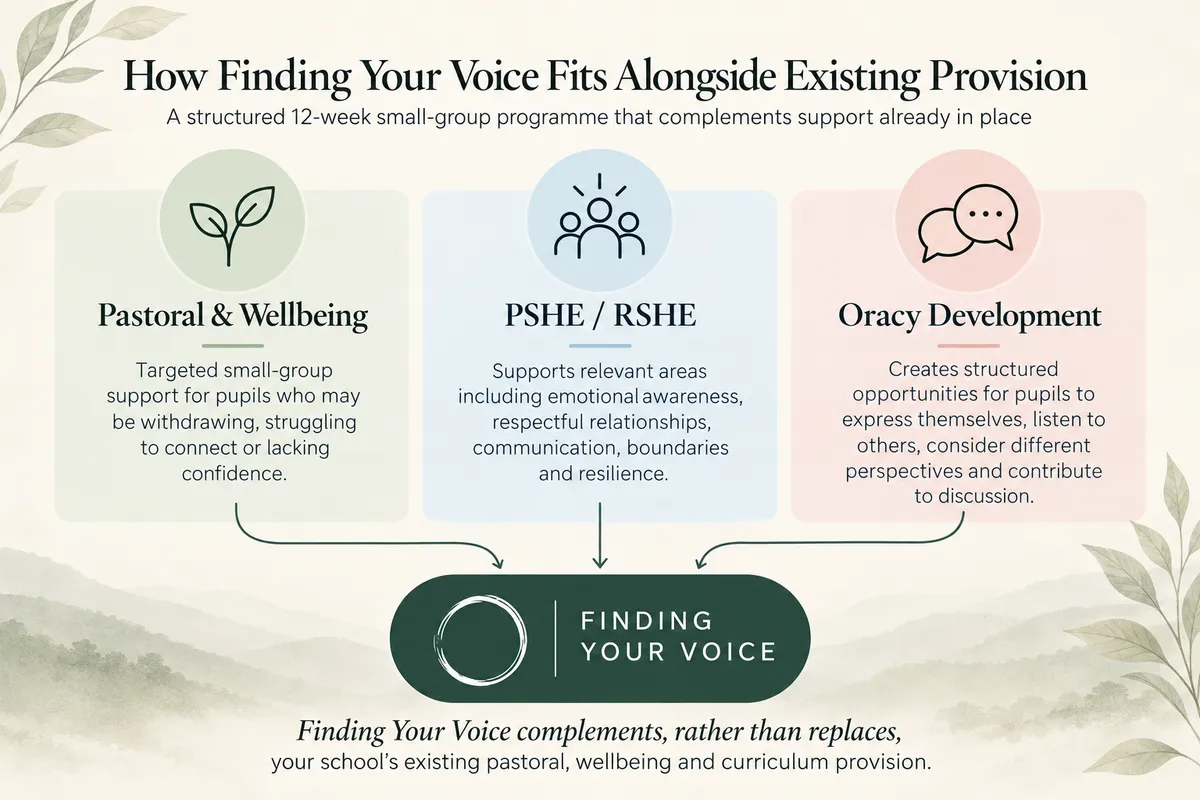
Supporting Your School's Pastoral, SEND and Personal Development Priorities
Finding Your Voice is designed to complement the work schools already undertake to support pupils' wellbeing, inclusion and personal development.
PASTORAL & SEND SUPPORT
Offers additional targeted small-group provision for pupils experiencing barriers involving communication, confidence, participation or connection.
PSHE, RSHE & HEALTH EDUCATION
Supports relevant areas of personal development, including emotional awareness, respectful relationships, self-expression, boundaries, trust and resilience.
ORACY & COMMUNICATION
Provides structured opportunities for pupils to practise speaking, listening, sharing perspectives and engaging in thoughtful group discussion.
Finding Your Voice complements rather than replaces a school's existing teaching, safeguarding, pastoral or specialist support.
Supporting Your School's Inclusion Priorities
Inclusive Mainstream Fund 2026–27
The Department for Education's Inclusive Mainstream Fund provides eligible mainstream schools in England with additional funding to strengthen inclusive provision and address barriers to learning and participation.
Its priorities include early, evidence-informed targeted support for pupils with additional needs, alongside approaches that encourage inclusion, belonging and participation.
Finding Your Voice offers schools a structured small-group intervention that can be considered as part of their wider inclusion planning, particularly where pupils would benefit from additional opportunities to develop self-awareness, communication and connection.
Schools determine how to use their funding allocations within the fund's conditions, taking account of their pupils' identified needs and existing provision.
Official guidance:
https://www.gov.uk/government/publications/inclusive-mainstream-fund-2026-to-2027
Considering how Finding Your Voice might fit within your school's inclusion strategy? We can explore this as part of an introductory conversation.
A Thoughtful Approach to Personal Development and Measuring Progress
Finding Your Voice draws upon principles of social and emotional learning, guided reflection and structured group discussion.
At its heart is the belief that greater self-awareness provides a valuable foundation for personal development. Giving pupils opportunities to recognise their thoughts, explore emotions and communicate with others can support the development of confidence, connection and resilience.
Schools understandably need to assess whether additional interventions are appropriate and beneficial for their pupils.
Finding Your Voice therefore includes a three-week review, allowing the school to consider participation, communication, peer interaction and early engagement.
Rather than introducing unnecessary pupil testing, this review can draw upon existing school-held information, supervising teacher observations and relevant feedback.
The focus is on understanding the pupils' experience, identifying any early changes and making an informed decision about continuing the programme.
Background educational research
The Education Endowment Foundation provides research summaries on approaches relevant to the design of Finding Your Voice:
Frequently Asked Questions
Which pupils is Finding Your Voice designed to support?
Finding Your Voice is designed for small groups of secondary-school pupils in Key Stages 3 and 4 who may benefit from additional opportunities to develop self-awareness, communication, confidence and connection.
Schools select participants based on identified needs and the suitability of the group environment.
Are pupils expected to share personal experiences?
Pupils are encouraged to participate at a level that feels appropriate for them. Reflection and conversation are supported rather than forced, and pupils are not expected to disclose personal experiences to the group.
The intention is to create a respectful space where listening, reflection and expression all have value.
How much time is required from school staff?
Each circle runs for one hour per week. A designated school staff member supports the sessions and safeguarding arrangements, while staff who will facilitate future circles participate in the agreed training and handover process.
The programme provides structured materials to support delivery and reduce additional preparation.
How is safeguarding managed?
Finding Your Voice operates alongside the school's established safeguarding policies and procedures.
Safeguarding arrangements are agreed with the school in advance, with a designated member of staff available during sessions. Any concerns are reported and managed promptly through the school's safeguarding processes.
How will we know whether the programme is making a difference?
The school can use relevant existing information and supervising teacher observations to explore changes in areas such as communication, participation and peer interaction.
An initial review takes place after three weeks, with further reflection and evaluation as the programme progresses.
The intention is to make evaluation proportionate and meaningful without turning pupils' personal reflection into a formal assessment.
Does Finding Your Voice replace counselling, PSHE or existing pastoral support?
No. Finding Your Voice is a structured educational and personal development intervention, rather than a clinical or therapeutic service.
It is designed to work alongside existing school provision, providing additional opportunities for self-awareness, reflection, communication and connection.
Can the school continue running circles after the initial programme?
Yes. The programme includes staff training, facilitator resources and a one-year licence supporting further school-led use within the agreed terms.
The gradual transition towards school-led delivery is designed to help schools develop their own capability and continuity.
What changes when young people feel heard?
CONFIDENCE
Young people become more comfortable putting their thoughts into words, sharing their perspective and contributing when they choose to.
CONNECTION
By listening and being listened to, students build stronger relationships, empathy and a greater sense of belonging.
SELF-AWARENESS
Regular reflection helps young people better understand their thoughts, feelings and experiences — giving them greater awareness of themselves and how they respond.
Your questions, answered.
Everything you need to know about bringing Finding Your Voice into your school. From the three-week pilot and staff commitment to safeguarding, training and what happens next.
How does the three-week pilot work?
The pilot gives your school an opportunity to experience Finding Your Voice before committing to the full programme. Scott facilitates the first three weekly sessions with a circle of up to twelve students, allowing staff to see the programme in practice and consider whether it is right for their school.
How much time and workload does this create for school staff?
Finding Your Voice has been designed to work within the realities of a busy school. Sessions run for approximately one hour each week, with clear resources and a structured delivery model designed to keep additional preparation and administration to a minimum.
How is safeguarding managed?
Finding Your Voice works alongside the school's existing safeguarding policies and procedures. A designated member of school staff remains responsible for safeguarding, and any concerns arising through a session are managed through the school's established safeguarding processes.
How does Finding Your Voice fit alongside existing pastoral and PSHE provision?
Finding Your Voice is designed to complement, rather than replace, a school's existing pastoral and personal development provision. It provides dedicated time and structure for reflection, expression, communication and connection that can sit alongside the support already available to students.
How will we know whether the programme is making a difference?
Impact can be explored through student feedback, attendance and facilitator observations, alongside a simple end-of-programme questionnaire. The aim is to give schools useful evidence of changes in areas such as confidence, communication, self-awareness and connection without creating unnecessary additional administration.
Frequently Asked Questions
How does the three-week pilot work?
The pilot gives your school an opportunity to experience the first 3 sessions of Finding Your Voice with a group of up to 12 pupils.
The sessions are facilitated by Finding Your Voice, allowing pupils and staff to experience the approach before the school decides whether to continue with the full 12-week programme.
What time commitment is required from school staff?
Each Finding Your Voice circle runs for 1 hour per week.
During the initial stages, school staff have the opportunity to become familiar with the approach before gradually becoming more involved in delivery as the programme progresses.
How does Finding Your Voice fit with our existing RSHE and pastoral provision?
Finding Your Voice is designed to complement, rather than replace, your existing provision.
The programme supports key areas of statutory RSHE and Health Education including emotional awareness, expression, respectful communication, boundaries and trust, self-esteem and resilience.
How is safeguarding managed?
Finding Your Voice operates within the school's existing safeguarding policies and procedures.
A designated member of school staff remains available during sessions so that any safeguarding concern can be managed through the school's established procedures.
How do we know whether the programme is making a difference?
Finding Your Voice is designed to keep evaluation straightforward and proportionate.
Pupil feedback, staff observations and an end-of-programme questionnaire can provide the school with insight into pupils' experience of the programme and areas such as confidence, communication and self-awareness.
What happens after the initial 3-week pilot?
Following the pilot, the school can review the experience and decide whether it would like to continue with the remaining 9 weeks of the programme.
If the programme continues, staff training and supported implementation help prepare school staff to become increasingly involved in delivery.
A fifteen-minute conversation is an opportunity to discuss the needs you're seeing, explore how Finding Your Voice might complement your existing provision and consider whether a three-week pilot would be an appropriate starting point.
There's no need to make a decision about the full programme before having that conversation.


